

Vancouver Community College PIDP 3100 https://www.facebook.com/VCCSchoolOfInstructorEducation/
2024-13-11
Thematic Outline: The Need for Continuous Professional Development
It is only through receiving and processing stimuli that life is affirmed, similarly by an abundance of stimuli life is enriched. I see that today’s professional is a being of constant development or adaptation, and failure leads to irrelevance as this world becomes increasingly intolerable to stagnation. Therefore, it becomes necessary to forge connections through different systems, developmental ideas, and other professionals to continuously innovate, evaluate, propagate ideas and methods or systems to foster, control or channel and develop today’s professional.
Thematic Outline: The Need for Continuous Professional Development
I. The Importance of Stimuli
Life is affirmed and enriched through receiving and processing stimuli.
Stagnation leads to irrelevance in an ever-changing world.
II. The Modern Professional: A Being of Constant Development
- Professionals must constantly adapt and develop.
- Failure to do so results in irrelevance
- III. Strategies for Continuous Professional Development Connection: Forging connections with:
- Systems
- Developmental ideas
- Other professionals
- Innovation: Continuously innovating in terms of:
- Ideas
- Methods
- Systems
- Evaluation & Propagation: Evaluating existing and innovative approaches.
- Sharing knowledge and best practices.
- IV. The Goal: Fostering, Controlling, Channeling, and Developing Today’s Professional
Trends and Modern Technological advancements

Post#1
Modern Trends in my field
2024-17-11
Advancements in Technology
Today’s technicians find themselves in the eye of the tech storm. Every day, there is a new buzzword or technology that is now the latest or greatest, the holy grail or the one to save us all. How does one navigate today’s technology hype?
First, we need to know why there is a storm in the first place and that is Global Warming. Over the couple of decades scientist from many disciplines and nations have been sounding the call of our imminent demise if drastic measures are not implemented immediately some even go as far as to say it may even be too late, who will be proven right is yet to be seen. For our discussion however, we can see that from their many published studies a large body of data points to our dependence on fossil fuel being the driving factor to Earth’s warming and our impending doom thus the storm. See the link below for an in-depth discussion on global warming and its indices.
Read more: Adult Learning and The Art of the Connectionhttps://www.sciencedirect.com/topics/earth-and-planetary-sciences/global-warming-potential
The Storm
Those caught in this storm are buffeted by winds of change, progress, new discoveries, or technical breakthroughs in one area after another. If you are a Diesel Mechanic, then it may be the latest ECU fuel system, or engine design or you may even have expose to the new and upcoming Hydrogen technology in one way or another.
For Heavy Duty Techs it may be the new all electric Shovel or Haul truck or the latest diesel electric drive. For Auto technicians, there are numerous auto makers with full eDrive vehicles of hybrids. For electricians, the buzz word is solar. In whatever field you find yourself, the winds of change are blowing and some have been completely blown away lost to the winds of change for failing to adapt or innovate.
The Weatherman
There are still many eventful days ahead as governments and regulators figure out what to regulate to achieve what desired effect. For now, the drive is for an abundant renewable energy source, the two main ones now being wind, solar or hydrogen. There are also many arguments for nuclear energy and much research into nuclear fusion as a safer more powerful energy alternative. Over all the days are still cloudy with a strong possibility of showers as more companies and governments invest in alternative energy solutions, there are still many products left to wow us with promises of redemption and many policies and procedures for techs to sweat over.
Summary
Today’s technology is ever changing, what may seem new and innovative in on instance can in a next, be completely discarded. What’s for certain is that the world as it was known, has forever changed, today’s world is ever demanding and unforgiving. The result, Professionals who stagnate gets replaced, companies who fail to innovate dies. Whichever field you call yours, continue to grow, innovate and cultivate, become strong to weather the winds of change.

Post#2
2024-23-11
Trends in Modern Education
Competency Based Education
In the 21st century, global education trends are evolving to prepare students for a world that is increasingly interconnected and influenced by rapid technological advancements. The impact of emerging trends in education will spur student achievement and create global lifelong learners.
Rise of Competency-Based Education: Competency-based education, where students progress based on mastering specific skills rather than traditional grade levels, might become more prevalent based on growing support for the model. This approach allows for greater flexibility and a focus on ensuring that students are truly mastering the material before moving forward. (Laura Asicone. Dec.11/2023 Eschoolnews.com )
As Specialization becomes more widespread, Industry professionals are expected to have the training and or tools specific to their field to complete tasks proficiently. Competency-based training seems perfect for this approach and as stated by Laura Ascione quoted above there is growing support for this model.
The implication is self-evident, Specific training is required for specific fields and those wishing to become competent in those fields will therefore need to be specifically trained. Consider the latest eDrive system; while a base knowledge in electrical systems may be helpful or even necessary without specific training on the model eDrive in question, it may be impossible to provide timely competent service. As an instructor, it will become vital to stay informed of the developing trends to be able to continue providing courses that instill competence.
To Prepare for these challenges as an adult learner means being a constant learner myself. Some ways to do that is by; joining tech groups, brainstorming with other industry professionals, completing training courses when possible and developing the trainer’s mindset. By having a growth mindset, I will remain positive, continuing to learn and thereby inspiring similar qualities in my students.

Post#3
2024-01-12
Partner Call Summary
I was impressed by the initiative David displayed in encouraging his former employer to venture into new technologies, and the way he made it seem simple to develop and apply. Those of us with experience undertaking similar projects know that’s not the case (they don’t call growing Pain for no reason). No matter the industry, making changes aren’t usually readily accepted, whether it’s convincing your own team, boss, suppliers or your own customers, there are a number of challenges that must be successfully undertaken for a project to be considered successful. His post discussed how they successfully did just that even venturing into the dounthing realm of specialization with great results. Good job.
I also agree with his second post on Adult Learning trends and the importance of a flexible schedule. It has proven very difficult even impossible for most working adults to work full-time and pursue further training at the same time. Especially for trades persons who have irregular schedules with work that requires them to travel to various locations. I am concerned about necessary courses for my PIDP not being fully available online, especially since I am 16hrs away from the campus.

Post #4
Quote:
“…tests and grades are anathema to andragogy which assumes adults are capable of self-evaluating their own learning.” (Merriam & Bierema, 2014, p. 57/58)
Objective:
This quote anthropomorphizes “andragogy” by giving it feelings and thoughts. I think that the author intends to make an over-generalization that all adults in a learning environment vehemently dislike tests and grades and implies that they assume that they are capable of self-assessment. While I agree with the generalization, I disagree with a solely self-assessment approach to learning.
Reflective:
I chose this quote because I agree with the writer’s intent. I personally believe tests and grades are a poor means to measure one’s attainment. Though there are strong merits in using tests or grades, the current high stress methods of doing so, in my estimation, results in at best a superficial demonstration of a learner’s true ability. The effects of stress on a person’s cognitive decline, sometimes called stress bias, is featured in many studies. In one such study, Cortisol level rose by 15% during high stress test periods as opposed to low stress self-assessment periods. As professionals we also desire (if not demand) feedback on our performance and learning but if this is done in a high stress manner, the results are usually unsatisfactory. Please note the original quote, a “seemingly insurmountable obstacle to empirical studies of andragogy’s effectiveness, at least in terms of knowledge acquisition, is the catch-22 inherent within the very concept of Knowlesian andragogy: “effectiveness” is largely determined by learner achievement which is often measured by tests and grades; but for Knowles, tests and grades are anathema to the very idea of andragogy.” (RACHAL, May 2002)
however, Knowles does posit that “Andragogy assumes that the point at which an individual achieves a self-concept of essential self-direction is the point at which he psychologically becomes adult.” (Grace tatter 2019. Stress Bias, Knowles, 1973).
Interpretive:
Upon reflection, I feel that the authors wanted me to acknowledge students do not want to be tested or graded and are satisfied with their own self-assessment. Although this may be true, the current nature of education needs some form of testing to gauge the learners’ progress. My awareness of this thinking has increased, and I do acknowledge that many students strongly dislike or may even fear tests.
Decisional:
I am more aware of my adult learners’ feelings about tests and grades and will try to prepare them for tests not only by helping them to learn the intended material but also by helping them with studying and test-writing skills. I will take quantitative and continuous measures to overcome the test stress bias. Some ideas are; Regular informal quizzes and individual classroom presentations. The idea being to acclimatize the learner to being prepared to share their knowledge in a low stress non-confrontational manner. I can also incorporate some self-assessment into the course so that students can better gauge their own learning.
PIDP 3260

The Skillful Teacher
Vancouver Community College PIDP 3260 https://www.facebook.com/VCCSchoolOfInstructorEducation/
March 12 2025
3260 Post # Week 2
As I embark on my journey as an instructor/learner, I can’t but look in awe at the monumental task that is teaching and how as a learner/facilitator of knowledge there are/were so many concepts, theories and methodologies that were partially understood, new, unknown, unfamiliar, foreign and even novel (learning styles). There is an unbelievable amount of information and yet, there is still so much we don’t know or understand.
Stephen Brookfield wrote in his book about the “Truths of Teaching”. I found this fascinating because as a teacher and a parent there has been so many times where I too felt like an “Imposter”. Feeling I was no expert and having to make statements to that fact as a form of self preservation. I also agree with the truth that “I cannot motivate anyone to learn if at a very basic level they don’t wish to” (Stephen D. Brookfield, pg 9, 2015) and therefore focus on removing the barriers to learning and or looking out for teaching moments and maximizing their benefits/potential.
Like the AI generated picture above for this post, as teachers/facilitators of knowledge, we need exude confidence and competence as a basic requirement to build our learners own confidence. We work hard to do a good job of masking our own truths/frailties and hope that no one notices our obvious defects like the fingers of the AI generated picture above.

Reflective Writing 1A
March 22 2025
3260 Post# Week 3
Quote:
“As teachers we all bring different gifts and handicaps to the table.”
Stephen D, Brookfield
Objective:
This quote emphasizes the fact that as teachers we all make valuable contributions to our learner’s development but also along with these gifts, we also have drawbacks or handicaps that have far reaching implications for ourselves and learners. I was attracted to this quote because of its scope, it seems to me that these words could be applied in all aspects of our lives, not just the classroom.
Reflective:
I chose this quote because I agree with the writer’s intent. As humans we all live in our own unique microcosm of how we believe the world works or should work and that usually works out fine if those around us generally agree or share our world view, but when they do not, because of age, race, ethnicity or any other social divergent consideration, then that opens the door to a host of complications that could make a productive learning environment untenable.
As A teacher/parent I am often faced with a situation where my gifts are hampered or obstructed by my own inability to overcome my handicaps. Like tending to over share when I am excited.
Interpretive:
Upon reflection, I feel that Mr. Brookfield wanted me to acknowledge that in the context of a classroom environment, our skills/gifts as teachers can and will be affected by our own shortcomings. The idea around this quote was centered on cultural diversity in the classroom and the incapability of one person to surmount the difficulties of harmoniously relating to several cultural groups simultaneously. The Auther postulated a plausible solution by using teaching groups, though he acknowledges that there may be several difficulties in implementing this strategy. I find myself agreeing with Mr. Brookfield and acknowledge the difficulties inherent in today’s classroom. Understanding one’s own gifts and handicaps allows teachers to focus on their strengths and seek support in areas where they need it and by using teamwork when needed.
The modern classroom is one of diversity. My thinking and approach must change accordingly by developing skills and or strategies to overcome the cultural difficulties. One method that comes to mind is inviting guest lectures for each affected ethnic group.
Decisional:
I am more aware of my adult learners’ feelings and the challenges faced by both teachers and learners. By highlighting the unique strengths and weaknesses we each have as teachers, and by emphasizing the importance of self-awareness and teamwork, most of the negative effects of our own handicaps can be mitigated.
B.J. Neblett. Wrote in part: “We are the sum total of our experiences. Those experiences — be they positive or negative — make us the person we are, at any given point in our lives.”
By taking advantage of our own experiences and encouraging others to share their experiences in non-stressful productive discussions, we can foster a learning environment that thrives regardless of its diversity.
Some ways to carry out this are through small group projects, making the groups as diverse as possible. By inviting guest speakers that stand for each diversity. By using field trips or factory/site visits to expose my learners to real world environment and different work cultures. By creating new and varied experiences that would allow the learners to develop a wholesome view of themselves and their peers.
Feedback Instrument
March 30 2025
3260 Post# Week 4
Overall Purpose
The success of learning and teaching experience depends on students and instructor being aware of each other’s expectations, needs, and abilities. The purpose of this informal summative feedback instrument is to collect information on how well the students are learning in response to the instructor’s teaching and effectiveness in the classroom or during lab projects. The information will be used not just to know how students are experiencing the learning process but also on whether I need some improvement in some areas of teaching.
This summative feedback instrument will be used at the end of the course. This will enable me to adjust my teaching as encouraged by my student’s perspective to make a positive difference and help me correct and refine my methods.
Layout, Formatting and Directions
The Layout of the questionnaire conforms closely to a “white space” concept. The design is simple, easy to understand and likeable. The plain design keeps the respondents interested and less intimidating. The nine questions were intentionally made to fit on one page in a portrait orientation to make it looks like less work. The font is clear and simple, making it more appealing and engaging.
The format of the questionnaire is based on a “Likert Scale” which is the most common and universal method of collecting data from a survey. It does not require the respondents to take stand on a particular topic since it does not require them to provide a simple yes or no answer, but it allows them to response in a degree of agreement and disagreement. Also, it allows the participants to choose neutral if they are undecided. However, Likert Scale may miss valuable info that could offer much needed insight that can greatly aid in the learning and teaching process. In response to this, a comments space is provided for open ended responses, so participants may express their sincere thoughts.
The instruction for completing the Feedback Form is clear and direct to its purpose, which is to aid the instructor in improving his teaching skills and instructional methods. Also, the feedback will be used to improve future instructions to best meet students’ learning needs. The feedback result will be treated as confidential.
Analysis of Individual Items
Item #1: “Course objectives stated clearly.“
Teaching and Learning has clear goals and outcomes. By asking this question, I want to learn if I am being clear about the goals, expectations and outcomes of the course. This will justify the validity and reliability of my assessment in the future. Also, it will increase my credibility and authenticity as a teacher (Brooksfield, 2015). As an instructor, it is crucial for my students to know what my expectations are so that they can approach the course and assignments with clear goals and expectations.
Item #2: “Material presented in class matches syllabus.”
Since material being presented is the core of the course, it is one of the most crucial factors in the learning process of students, then the quality of said material is paramount and of equal importance is following the syllabus. Like this feedback instrument’s purpose with respect to the instructor, students need a good grasp on the expectations. The syllabus provides an outline, a road map if you will, it’s a crucial part of the learning process that gives them a map to chart their progress.
The purpose of this question is for me to know if the students believe that I have done enough during the course for them to comfortably feel that the material matches the syllabus. This can be challenging in courses like Power Generation where there is a lot of different equipment and a wealth of information so scaling and specifications become crucial.
Item #3: “Instructor responded questions.”
This question will allow me to assess the effectiveness of my teaching and how well I am doing in empowering my students to express themselves. If my students don’t believe I will address their questions, then they would be much less inclined to take part in class. This will tell me if I need to work harder at listening and how I am doing in creating a good classroom environment that is conducive to learning.
Item #4: “Instructor demonstrates adequate knowledge of course.”
This question will help me in assessing if my teaching methods and technique show my knowledge. Also, this will give me some idea if I need to change my presentation style or replace some technique to be more effective. It may also show areas in which I need to broaden my knowledge base. This question is particularly important to me as an instructor because it will tell me how confident the students are that I can deliver the subject efficiently and effectively. Their response to this question will tell me if they believe I am competent enough to handle the course.
Item #5: “Instructor uses appropriate teaching methods.”
This question is especially important, and the Likert-style question frees the students to give a more honest answer. Teaching in the trades is challenging because of the specifics and procedures involved. The fact that some of them a counter intuitive does not help when trying to inculcate best practice principles. As such, I want to see if my students understand or appreciate the teaching methods I am using.
Plan for Analysis and Implementation
One of the main components in conducting data gathering activities is efficiency. To promote efficiency in conducting surveys, researchers usually perform pilot surveys. I plan to pilot this feedback instrument in a core course to get a feel for data gathering and to prepare my students for future surveys. I intend to conduct a similar feedback instrument at the end of all my core courses in the future to make sure I am meeting the needs of the ever-changing demographic.
The activity will be done at the end of the course typically right after they are handed their completion documents when the stress of the course is gone, and they are more likely to answer the survey seriously.
Appropriate use of the Likert Scale and the analysis of the results has been debated by experts for over half a century now. Each one has their own views and valid arguments whether the data are ordinal or interval, parametric or non-parametric, and so on. A variety of experts’ recommendations are all present in articles when it comes to analyzing data from Likert Scale depending on what type of result a researcher wants. There are so many approaches to analyzing the Likert scale results ranging from Mann-Whitney U test, Chi square test, T-test, ordinal logistic regression, polychoric correlations and many more.
One weakness of the Likert Scale is that each item holds only comprehensive data. The difference between “slightly agree” which is less positive than “agree” cannot be quantified because the points on the individual scale are not numerical. Nevertheless, assigning a numerical value to items only express a “greater than” relationship, and how much greater is not implied.
When the data is collected and plugged into a suitable chart then by noting the frequency of occurrences of each item’s response one can organize data into some form of clarity. By applying reasonable judgement, we can extrapolate to a reasonable degree what the students have to say about the subject matter in question. The written comments are also valuable and will be crucial in considering the feedback.
After a full-scale survey, I will consider all information and discuss the feedback results if needed and collaborate with students/peers to create a strategy to implement changes where necessary.

Reflective writing 1B
April 6 2025
3260 Post# Week 5
Quote:
“Simply having experiences does not imply that they are reflected on, understood or analyzed critically. Individual experiences can be distorted, self-fulfilling, unexamined and constraining.” (S. Brookfield. 2015. p12)
Stephen D, Brookfield
Objective:
This quote says that having experience is important and often invaluable but that depends on how said experiences are evaluated, represented or harnessed. Brookfield, in his book in chapter one under the topic Being Expert on Our Own Teaching, speaks about the importance of one’s own experience, postulating that we as teachers are often experts in our own field. Therefore, our own experiences when properly harnessed are invaluable as a go to source when faced with various teaching difficulties. I was attracted to this quote because I agree that one’s own experiences are valuable, but they can also be damaging.
Reflective:
I chose this quote because I agree with Brookfield’s postulation. As humans we all live in our own unique microcosm of how we believe the world works or should work and that usually works out fine if those around us generally agree or share our world view, but when they do not, because of age, race, ethnicity or any other social divergent consideration, then that opens the door to a host of complications that could make a productive learning environment untenable.
As teachers, myself included, we all have various experiences, some for decades, others not so long, regardless, they are all valuable and we would benefit immensely if we accepted that and worked at harnessing their true value.
Interpretive:
Upon reflection, I feel that Mr. Brookfield wanted me to acknowledge that in the context of a classroom environment, my experiences can be a boon or a deterrent to various aspects of the classroom environment. For instance, he wrote that we could become victims of “Groupthink” saying that “Experiences can be narrowing and constraining, causing us to evolve and transmit ideologies that skew irrevocably how we interpret the world. A group’s pooling of individual experience can result in a myopic exchange of prejudices.” This would be especially damaging if someone from a more closed ethnic group was put in charge of a modern classroom which is one of diversity. My thinking and approach must change accordingly by developing skills and or strategies to overcome the cultural difficulties. One method that comes to mind is to draw upon my own experience in dealing with diverse groups and seeking the aid of my colleagues from various ethnic groups.
Decisional:
I am more aware of my adult learners’ feelings and the challenges faced by both teachers and learners. By highlighting the unique strengths and weaknesses we each have as teachers, and by emphasizing the importance of self-awareness and teamwork, most of the negative effects of our own experiences can be mitigated or eradicated. There are various resources available through colleagues, faculty or online resources such as websites like Minority Rights Group. Minority Rights Group is the leading human rights organization working with ethnic, religious and linguistic minorities, and indigenous peoples worldwide. (https://minorityrights.org/).
B.J. Neblett. Wrote in part: “We are the sum total of our experiences. Those experiences — be they positive or negative — make us the person we are, at any given point in our lives.”(B.J. Neblett, 2009)
By taking advantage of our own experiences in an evaluated unquantified manner and encouraging others to share their experiences in non-stressful productive discussions, we can foster a learning environment that thrives regardless of its diversity.
Some ways to carry out this are through small group projects, by having workshops that show the value of valuable experience and making the groups as diverse as possible. By inviting guest speakers that stand for each diversity. By using field trips or factory/site visits to expose my learners to real world environment and different work cultures. By creating new and varied experiences that would allow the learners to develop a wholesome view of themselves and their peers.
Post # Week 6-7 coming soon
PIDP 3351
The Learner’s Mindset
Vancouver Community College PIDP 3351 https://www.facebook.com/VCCSchoolOfInstructorEducation/
April 10 2025
33351 Post#Module 1
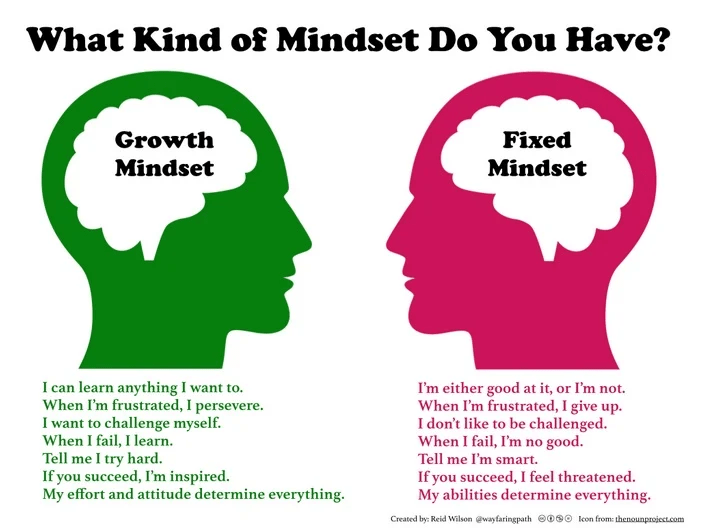
Are you a fixed or growth mindset individual and why is that important?
As seen from the infographic above, the Fixed Mindset individuals dislike challenges, are thwarted by frustration, lack self-esteem or are threatened by others’ success.
The Growth Mindset individuals however have a significantly different outlook; can learn anything, persevere through frustrations, are ready for challenges and are inspired by others success. They have a Learner’s mindset, but what is a Lerner’s Mindset and how does one cultivate it? The proceeding video by Dr. Dwayne Harapnuik explain the concepts involved.
How to Reignite your Learner’s Mindset.
Dwayne Harapnuik Revised July 1, 2021
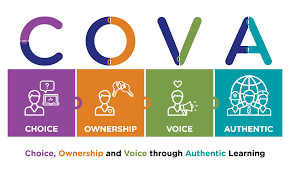
In this video DR. H, describes the steps required to change one mindset and the changes necessary to actualize the desired change. He introduces concepts like Reigniting your learners Mindset and COVA, Choice through Ownership and Voice through Authentic learning.
You would not be alone if you immediately think “I already have a growth mindset”. Many people believe that. But is that really the case and can you tell the difference? Please watch the next video and see if there really is a difference.
What Having a “Growth Mindset” Actually Means.
Dwayne Harapnuik — September 16, 2024.
3 Common Growth Mindset Misconceptions
- I already have a Growth Mindset
- A Growth Mindset is just about praising and rewarding effort
- Just espouse a Growth Mindset and good things will happen
This is perhaps why we need to consider moving to a Learner’s Mindset.
So, what do you think? Whatever your take-away is, I hope that it has been made abundantly clear what a Learner’s/ Growth mindset is and how important it is for your and my future development.
Adopt a Learner’s Mindset
The first step to learning anything you want is to believe you can learn it. This is a learner’s mindset, also known as a growth mindset. The idea is rooted in the concept of neuroplasticity, the brain’s ability to reformat its neural pathways, adapting to change throughout our lives.
In Mindset, psychologist Carol S. Dweck differentiates between a growth mindset and the more common fixed mindset, in which you believe your abilities are unchangeable and that you were born with a certain amount of intelligence. On the other hand, if you adopt a growth mindset, you view your innate abilities as a starting point on which you can build with hard work, persistence, and the right learning strategies.
When you have a fixed mindset, you believe (or were told) that you were born with specific traits and a certain, unchangeable amount of intelligence. Dweck and Boaler both assert that many of us are trained in this false mindset from an early age—for instance, by teachers who believe that intelligence, inherent talent, or differences based on gender and race determine everything.
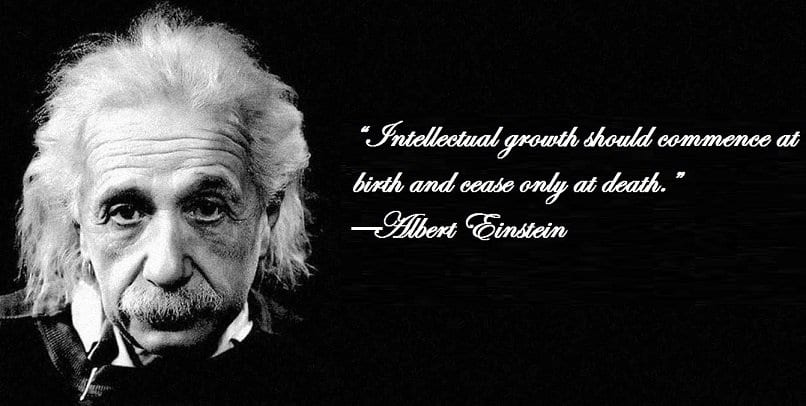
I will end the discussion by leaving you this thought by a now undisputed genius;

Assessment Of/For/As Learning
April 11 2015
3351 Post# Module 2
Welcome Back.
Today I want to share with you my process by which I plan to implement the Assessment Of/For/As Learning methodology.
First as a reminder let define Assessment Of/For/As Learning;
Assessment Of/For/As Learning
For those who prefer a more typical written definition the New South Wales (Australia) Education Standards Authority (2017) provide a good summary of “assessment for, as, and of learning”
Assessment of learning assists teachers in using evidence of student learning to assess achievement against outcomes and standards. Sometimes referred to as ‘summative assessment’, it usually occurs at defined key points during a teaching work or at the end of a unit, term or semester, and may be used to rank or grade students. The effectiveness of assessment of learning for grading or ranking purposes depends on the validity, reliability, and weighting placed on any one task. Its effectiveness as an opportunity for learning depends on the nature and quality of the feedback.
Assessment for learning involves teachers using evidence about students’ knowledge, understanding, and skills to inform their teaching. Sometimes referred to as ‘formative assessment’, it usually occurs throughout the teaching and learning process to clarify student learning and understanding.
Assessment as learning occurs when students are their own assessors. Students monitor their own learning, ask questions and use a range of strategies to decide what they know and can do, and how to use assessment for new learning.
Intent
Though my students are working professionals in technical trades and are there skewed to a more formative structure of assessment, I plan to shift to a AaL assessment process by making the class discussions, workshops and labs a significant part of the final assessment. The intent being if a learner does well in these areas, they can successfully complete the course even if their end of course test score is not that great.
Implementation- a Five Step Process.
Step 1. Understanding of Assessment Of/For/As Assessment
Using methods from Chappuis et al. (2011), I will provide a clear framework of AoL, AaL, and AfL. Using the resources and infographic at National Forum for the Enhancement of Teaching and Learning will help students grasp the significance of diverse assessment strategies.
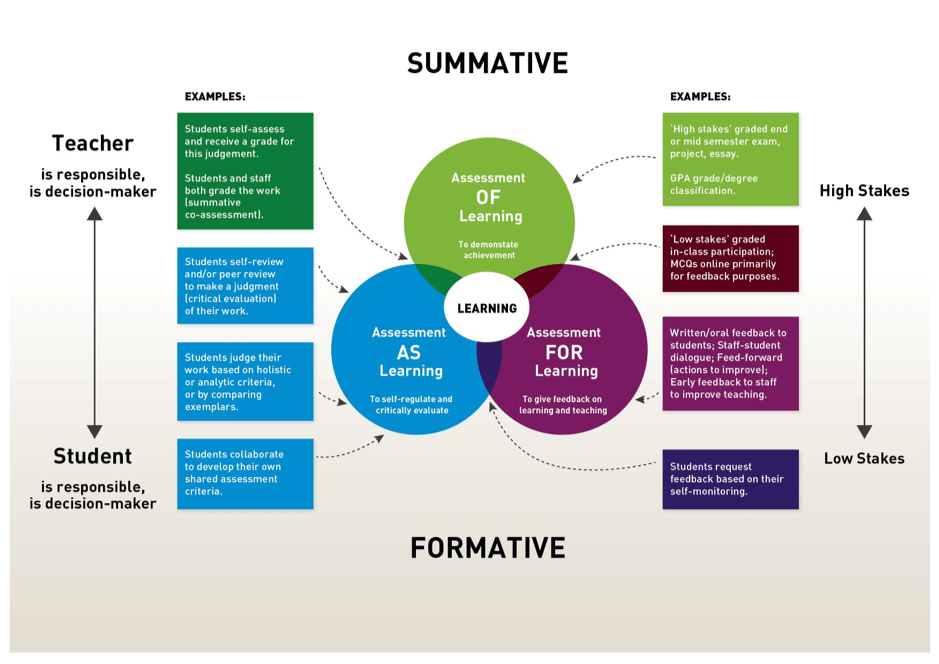
Step 2. Introduction to Key Features of Assessment Of/For/As Learning
The following assessment OF/FOR/AS learning table is a compilation of from a wide variety of resources that goes a bit further than simple definitions (Chappuis et al., 2012; Fenwick & Parsons, 2009; McNamee & Chen, 2005; Rowe, 2012; Schraw, 2001; Sparks, 1999):
| Assessment | Of Learning | For Learning | As Learning |
| Type | Summative | Formative | Formative |
| What | Teachers determine the progress or application of knowledge or skills against a standard. | Teachers and peers check progress and learning to help learners to determine how to improve. | Learner takes responsibility for their own learning and asks questions about their learning and the learning process and explores how to improve. |
| Who | Teacher | Teacher & Peers | Learner & Peers |
| How | Formal assessments used to collect evidence of student progress and may be used for achievement grading on grades. | Involves formal and informal assessment activities as part of learning and to inform the planning of future learning. | Learners use formal and informal feedback and self-assessment to help understand the next steps in learning. |
| When | Periodic report | Ongoing feedback | Continual reflection |
| Why | Ranking and reporting | Improve learning | Deeper learning and learning how to learn |
| Emphasis | Scoring, grades, and competition | Feedback, support, and collaboration | Collaboration, reflection, and self-evaluation |
If we want to encourage our learners to become more autodidactic it would then seem reasonable to shift from assessment of learning to assessment for learning and ultimately get to assessment as learning. We see this perspective from Lorna Earl (2012) in her highly cited text Assessment as Learning: Using Classroom Assessment to Maximise Student Learning.
Step 3. Putting AfL/AoL/AaL into Action-Planting the seeds of the Growth Mindset
Through class projects, workshops and group assignments. I will monitor my learners’ progress and guide them to reflect on their learning and develop their self-assessment skills. This process aligns with Fenwick and Parsons’ (2009) approach to evaluation and reflection.
Step 4. Cultivating an Appreciation for Assessment Mindset
As discussed by McNamee and Chen (2005), I will demonstrate how the integration of assessment and teaching bridges the gap between understanding and application. Learners will witness the practical implications of their acquired knowledge. When my learners begin to see the positive benefits of Choice Ownership and Voice then they will truly make the learning process their own and like Dr. H said, you won’t be able to take it away from them. Please see Dr. Harapnuik’s video below for more info;
Step 5. Timely Personalized and Positive Feedback
Regular timely, positive and constructive feedback will demonstrate to my learners that I take ownership of the process. Working within their expectation and appreciation by providing learners with individualized feedback, encouraging them by making the assessment clear, concise and making use of Yet where possible. (Sparks, 1999/Dwek. Carol 2016).
Resources
All resources can be found here. In addition to these articles, any references related to citations in the blog should be found here.
Stephen D. Brookfield. (2015) The Skillful Teacher, Third edition.
Shors, T. (2004). Learning during stressful times. Learn Mem, 11(2), 137–144. doi:doi:10.1101/lm.66604
LUMSDEN, D. (1987). How Adults Learn. Generations: Journal of the American Society on Aging, 12(2), 10-15. Retrieved from http://www.jstor.org/stable/44873161
Merriam, S. B., & Bierema, L. L. (2014). Adult learning : linking theory and practice. San Francisco, CA: Jossey-Bass, a Wiley brand.
Skinner, B. (1971). Beyond Freedom and Dignity. Harmondsworth, Middlesex, England : Penguin Books Ltd.
Titchener, E. B. (1914). On “Psychology as the Behaviorist Views It”. (pp. 1-17). Philadelphia: American Philosophical Society. Retrieved from https://www.jstor.org/stable/984126
Watson, J. B. (1913). Psychology as the Behaviorist Views It. Psychological Review, 158-177.
Knowles, M. (1973). The Adult Learner: A Neglected Species. Houston, Texas: Gulf Publishing Company.
Laura Ascione. 2023/12/11, https://www.eschoolnews.com/it-leadership/2023/12/11/current-trends-in-education/
Merriam, S. B., & Bierema, L. L. (2014). Adult learning : linking theory and practice. San Francisco, CA: Jossey-Bass, a Wiley brand.
Grace Tatter (2019) Tests and Stress Bias. Strengthening the correlation between student stress levels and high-stakes tests. Jennifer Heissel, Emma Adam and David Figlio, Jennifer Doleac and Jonathan Meer.
Chappuis, J., Stiggins, R. J., Chappuis, S., & Arter, J. (2011). Classroom assessment for student learning: Doing it right-using it well. Pearson Upper Saddle River, NJ.
Fenwick, T. J., & Parsons, J. (2009). The art of evaluation: A resource for educators and trainers. Thompson Educational Publishing.
Harapnuik, D. K. (n.d.). Assessment OF/FOR/AS Learning. It’s About Learning., Assessment as Learning https://www.harapnuik.org/?p=8475
National Forum (2021). Expanding our understanding of assessment and feedback in irish higher education. National Resource Hub (Ireland). Retrieved from: https://hub.teachingandlearning.ie/resource/expanding-our-understanding-of-assessment-and-feedback-in-irish-higher-education/
References
1. Brookfield, Stephen. (2015). The Skillful Teacher. San Francisco, CA. Jossey-Bass, a Wiley Imprint. www.josseybass.com
2. Sullivan, G.M., Artino, A.R. (2013). Analyzing and Interpreting Data from Likert-type Scale. Retrieved May 3, 2017 https://www.ncbi.nlm.nih.gov/pmc/articles/PMC3886444/
3. Harapunik, Dwayne. (2021) It’s About Learning, Reignite Your Learner’s Mindset. https://www.harapnuik.org/?page_id=9069
4. Harapunik, Dwayne. (September 16, 2024) Its About Learning, what having “Growth Mindset” actually means. https://www.harapnuik.org/?p=9632
5. Larry Ferlazzo | Apr 21, 2016, | The Best Resources On Helping Our Students Develop A “Growth Mindset”
Dweck. Carol., 2006 Mindset: The New Psychology of Success.
https://www.gse.harvard.edu/ideas/usable-knowledge/19/02/tests-and-stress-bias
Nuclear innovations;
Solar innovations;
https://tamesol.com/future-of-solar-energy/
Wind innovation;
https://www.energy.gov/eere/wind/next-generation-wind-technology
Hydrogen innovation;
https://guidehouseinsights.com/subscription-services/hydrogen-innovations
B.J. Neblett (George (Part One) by BJ Neblett © 2009)
Minority Rights Group.

 Adult Learning Innovations